The Fundamental Difference in One Sentence
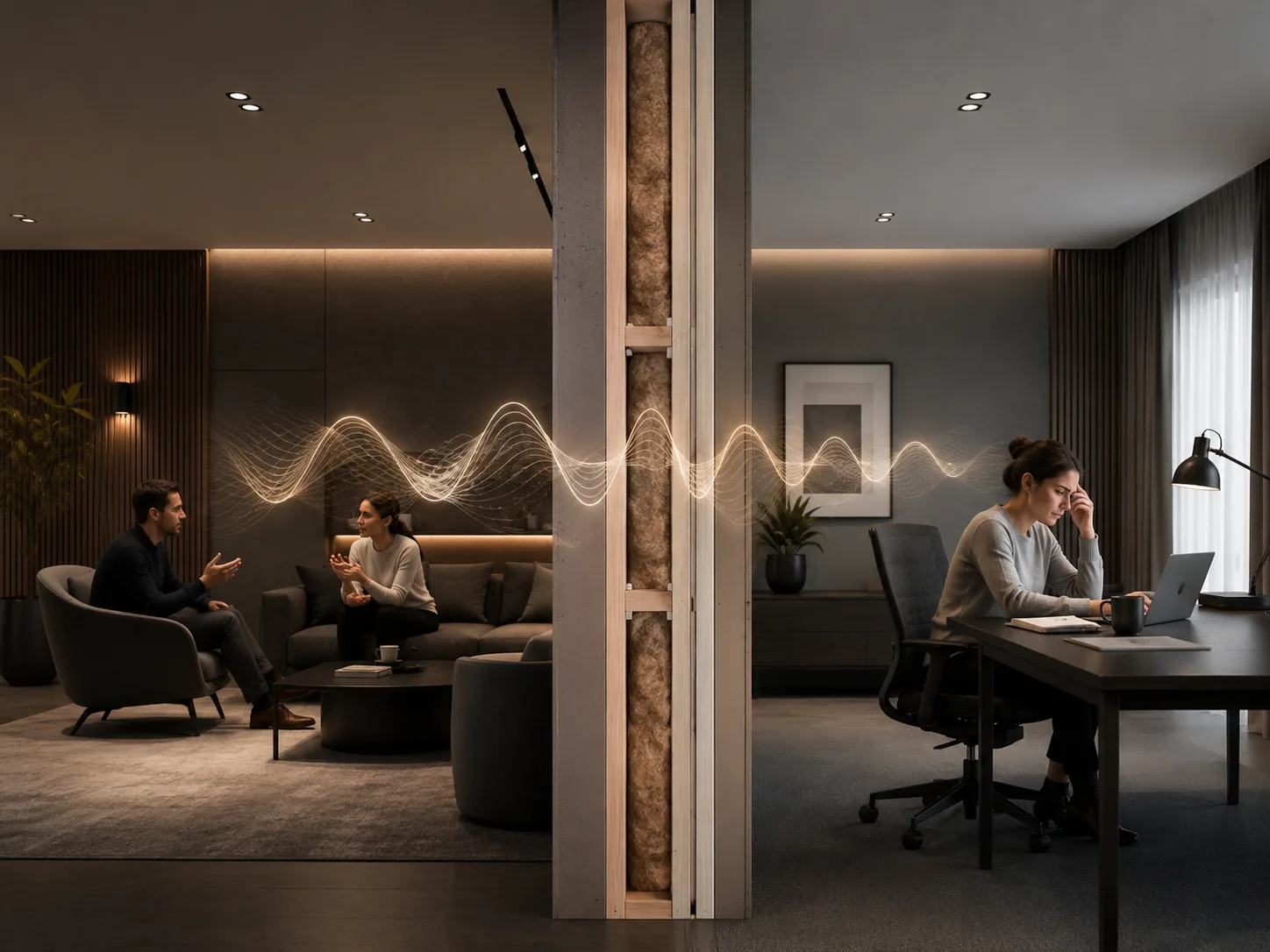
Sound absorption controls what happens to sound inside a room; sound insulation controls how much sound passes between rooms. They solve different problems, use different metrics, and are addressed by different materials and systems. Most projects need a clear understanding of both to choose correctly.
Sound Absorption — What Happens Inside the Room
Sound absorption reduces echo and reverberation inside a space. When sound strikes an absorbing surface, part of its energy is converted to heat instead of reflecting back. The result is a quieter, clearer room — better speech intelligibility and less noise build-up.
Absorption is described by:
- NRC — the single-number rating of a material's absorption (What Is NRC?).
- SAA and αw — related single-number absorption ratings (explained in the NRC article).
- RT60 — the room's reverberation time, which absorption shortens (What Is RT60?).
Sound Insulation — What Happens Between Rooms
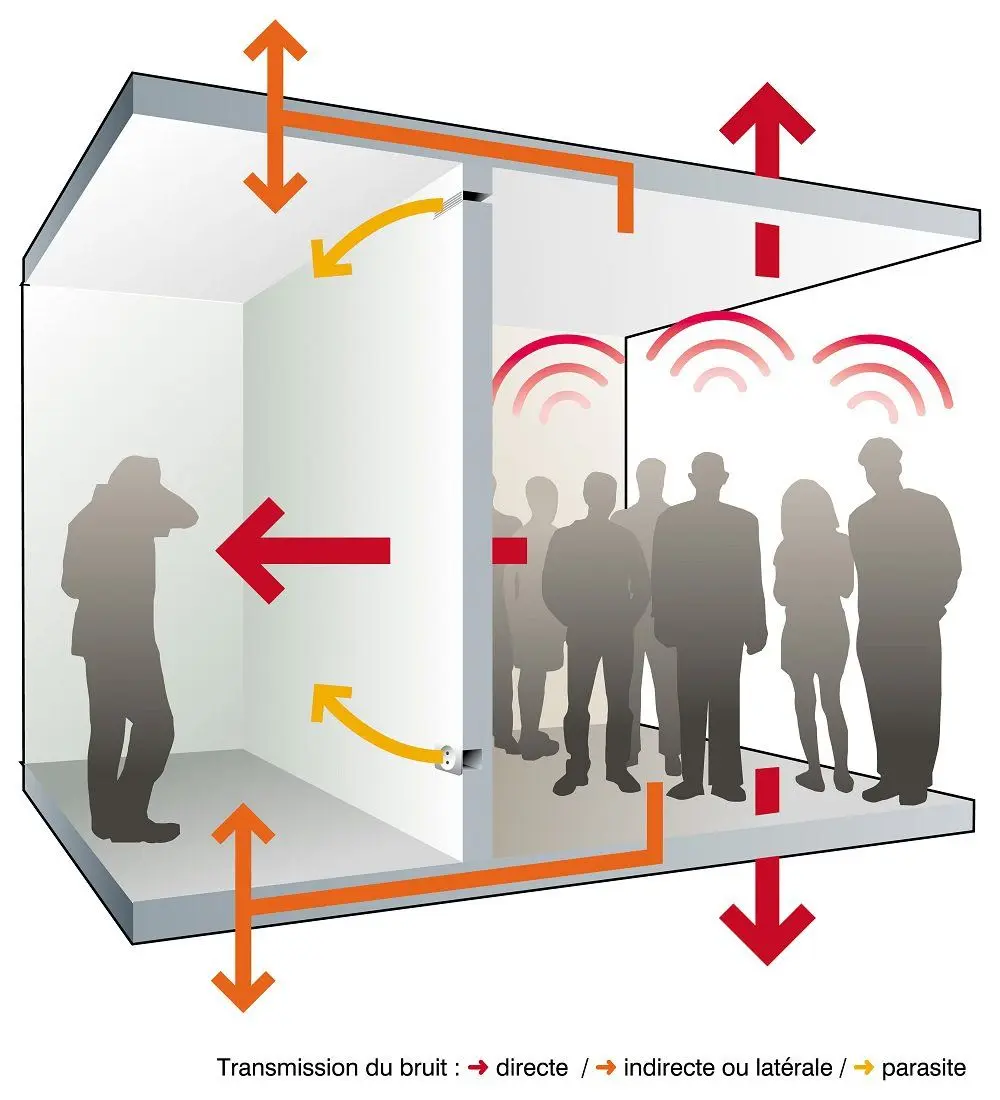
Sound insulation reduces the sound that passes through a building element — a wall, floor, ceiling, door or window. The goal is to stop a conversation, a television or street noise from being heard on the other side.
Insulation is described by:
- Rw — the ISO single-number rating of airborne sound insulation (What Is Rw?).
- STC — the ASTM single-number rating of airborne sound insulation (What Is STC?).
- Transmission Loss and Flanking Transmission — the underlying frequency-dependent measure and the real-world paths that reduce on-site performance (explained in the Rw and STC articles).
Master Comparison Table
| Concept | Measures | Applies To | Typical Metric | Main Standards |
|---|---|---|---|---|
| NRC | Sound absorption | Material (panel, foam) | Unitless (0.00–1.00) | ASTM C423, ISO 354, ISO 11654 |
| RT60 | Reverberation (sound decay) | Room | Seconds (s) | ISO 3382-1 / 3382-2 |
| Rw | Airborne insulation (ISO) | Building element/system | dB | ISO 10140, 717-1, 16283 |
| STC | Airborne insulation (ASTM) | Building element/system | Rating (unitless) | ASTM E90, E413, E336 |
Decision Framework
Use this simple guide to identify which problem you are solving (it is a starting point, not a final engineering diagnosis):
- Echo / reverberation inside the room → Room acoustic treatment → NRC / RT60.
- Noise passing between rooms → Sound insulation → Rw / STC.
- Poor speech intelligibility → Room acoustics → RT60 + absorption (plus other factors).
- Mechanical / HVAC noise → a separate acoustic assessment (source, path and structure must all be evaluated).
Common Questions, Answered Directly
"Do I need acoustic treatment or soundproofing?" If the problem is echo inside the room, you need treatment (absorption). If the problem is sound leaking to or from another room, you need insulation. Many spaces need both.
"Does a PET panel insulate against sound?" A PET panel is primarily an absorption product. It reduces echo inside a room but does not, by itself, provide sound insulation between rooms. Insulation requires a complete tested wall or ceiling assembly.
"Does NRC measure soundproofing?" No. NRC measures absorption. Soundproofing (insulation) is measured by Rw or STC.
"Are Rw and STC the same thing?" They are the ISO and ASTM counterparts of airborne insulation, but they use different rating procedures and are not automatically equal.
Related Products — Absorption
For echo and reverberation control inside a room (sound absorption):
Related Products — Insulation
For blocking sound between rooms (sound insulation — performance applies to a complete, tested assembly):
Read More — The Acoustic Fundamentals Series
What Is NRC? · What Is RT60? · What Is Rw? · What Is STC?
For help choosing the right solution for your project, contact us for a free acoustic consultation.
Frequently Asked Questions
Can one product do both absorption and insulation? Generally not. Absorption materials (panels, foam, baffles) control echo inside a room; insulation is achieved by complete wall/ceiling assemblies. Some assemblies combine both functions, but they are still designed as systems, not single materials.
Do I always need both? Not always. A room with a hard, echoey surface needs absorption; a noisy neighbour or street needs insulation. Assess which problem you actually have.
Is NRC more important than STC? Neither is "more important" — they answer different questions. You need the metric that matches your problem.
Verified Sources
- ASTM C423 / ISO 354 / ISO 11654 — sound absorption.
- ISO 3382-1 / 3382-2 — reverberation time.
- ISO 10140 / ISO 717-1 / ISO 16283 — airborne sound insulation (ISO).
- ASTM E90 / ASTM E413 / ASTM E336 — airborne sound insulation (ASTM).
Share this article
Related articles

Acoustic Panels in Tabuk and NEOM: Mega-Projects Guide (2026)

Acoustic Panels in Riyadh: A Guide for Engineers and Contractors (2026)