— FREQUENTLY ASKED —
Quick Answers
What is MLV (Mass Loaded Vinyl)?
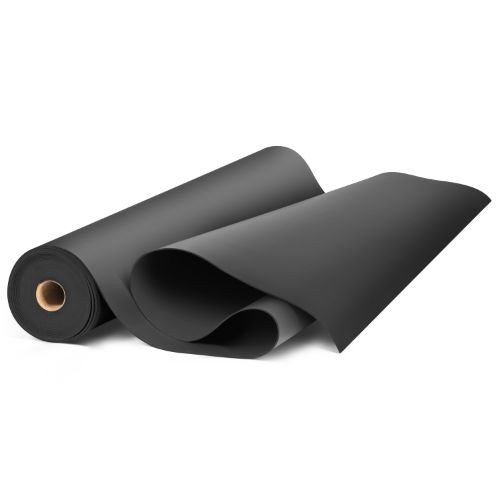
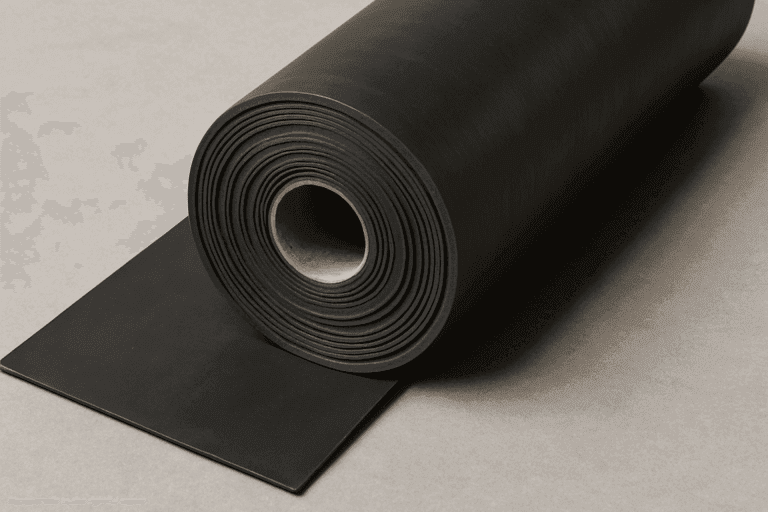
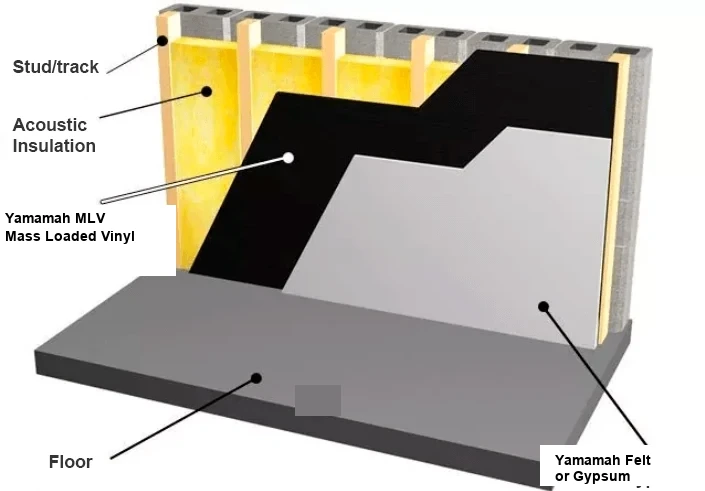
A thin, flexible, high-density soundproofing material made from PVC loaded with heavy fillers — weighing 4.8 kg/m² with density of 1,800 kg/m³, designed to add mass to walls, ceilings and floors to block airborne sound.
How much noise reduction does it provide?
Standalone STC rating of 33 dB. Combined with standard wall assemblies (drywall + insulation), it achieves 50-60 dB STC — sufficient to block normal speech, TV and household noise.
Can it be used for floor sound insulation?
Yes — MLV is excellent for floor insulation under carpet, hardwood, laminate and tile. It significantly reduces both airborne noise and impact noise between floors.
Is MLV fire resistant and safe indoors?
Yes. Class B fire rating (B-s1, d0) with very low smoke production, antimicrobial and waterproof — safe for hospitals, schools and food service areas.
Does it require maintenance?
No. The material is chemically stable and resistant to moisture, insects and mold — maintains performance for decades without maintenance.
What is MLV made from and how has the material evolved?
Mass Loaded Vinyl is a viscoelastic composite: a flexible PVC (polyvinyl chloride) matrix loaded with dense mineral fillers such as calcium carbonate or barium sulfate to reach 1,800 kg/m³. The technology has been used in industrial sound control since the 1960s. Yamamah supplies the modern generation — with tighter density tolerances, low-VOC formulations, and Class B fire performance.
How does MLV physically block sound?
MLV works through mass and internal damping (hysteresis). Its high density reflects most airborne sound waves back to the source, while the viscoelastic nature causes the remaining vibration energy to dissipate as tiny amounts of heat inside the material itself. This dual mechanism — reflect + dampen — gives MLV a much broader frequency response than simple rigid barriers of the same weight.
Can I glue MLV directly onto a wall without air gap or drywall?
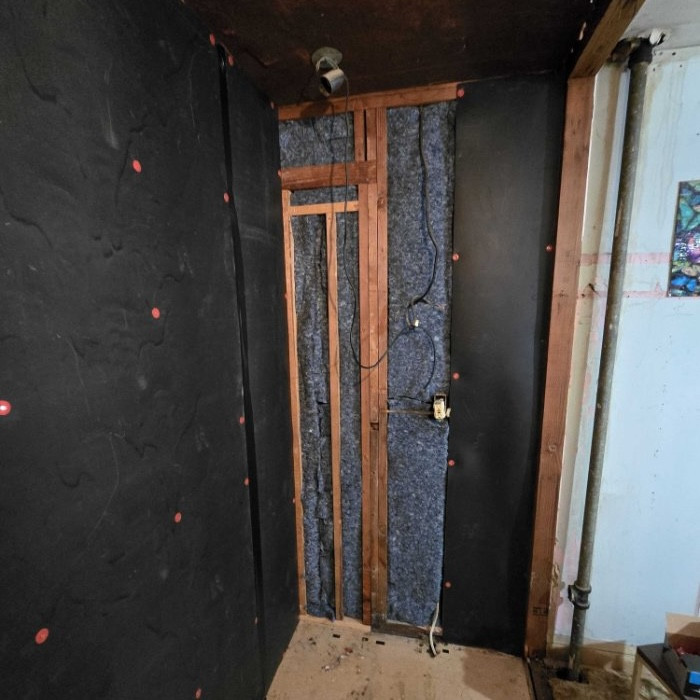
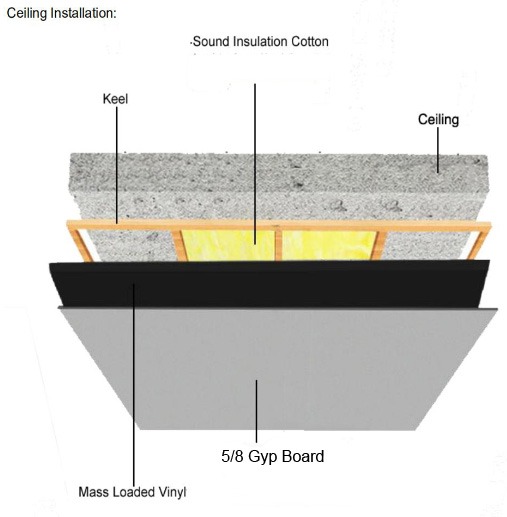
No — direct-bonding MLV to a rigid wall or partition cripples its performance. The MLV needs a small degree of independent vibration to convert sound energy into internal damping. Bond it directly and you lose most of the STC gain plus you risk mechanical damage over time. Yamamah always installs MLV as a decoupled layer: either hung freely, sandwiched between two layers of drywall, or clipped on resilient channels.
Does the direction of MLV installation matter — vertical vs horizontal?
Orientation itself has no measurable acoustic effect. What matters is minimizing joints and sealing them fully. Every unsealed seam is a direct sound leak, so we plan the roll layout to reduce the total joint length and always tape or overlap seams with acoustic sealant. On tall walls we prefer vertical drops (fewer horizontal seams); on ceilings we align rolls parallel to the shortest span.
Is a thicker or heavier MLV always better?
For low-frequency sound (bass, HVAC rumble, traffic), yes — more mass = better attenuation. But at mid and high frequencies you gain much less per extra kilogram, and heavier sheets are harder to install and load ceilings more. Density and mass matter more than raw thickness: a 3 mm sheet at 1,800 kg/m³ (5.4 kg/m²) will out-perform a 5 mm sheet at 1,200 kg/m³ (6 kg/m²) at low frequencies despite similar total mass. Yamamah's 3 mm × 1,800 kg/m³ is the industry-standard sweet spot for STC 33.
Can MLV wrap water and HVAC pipes to stop noise transmission?
Yes — MLV is one of the best solutions for noisy plumbing risers and HVAC ductwork. The flexible sheet wraps directly around the pipe, blocking the airborne and low-frequency structure-borne noise that hard insulation cannot handle. For pipes we recommend the aluminium-foil-backed variant: the foil adds a vapour barrier, resists moisture, and improves handling. Yamamah supplies foil-backed MLV in matching 3 mm density.