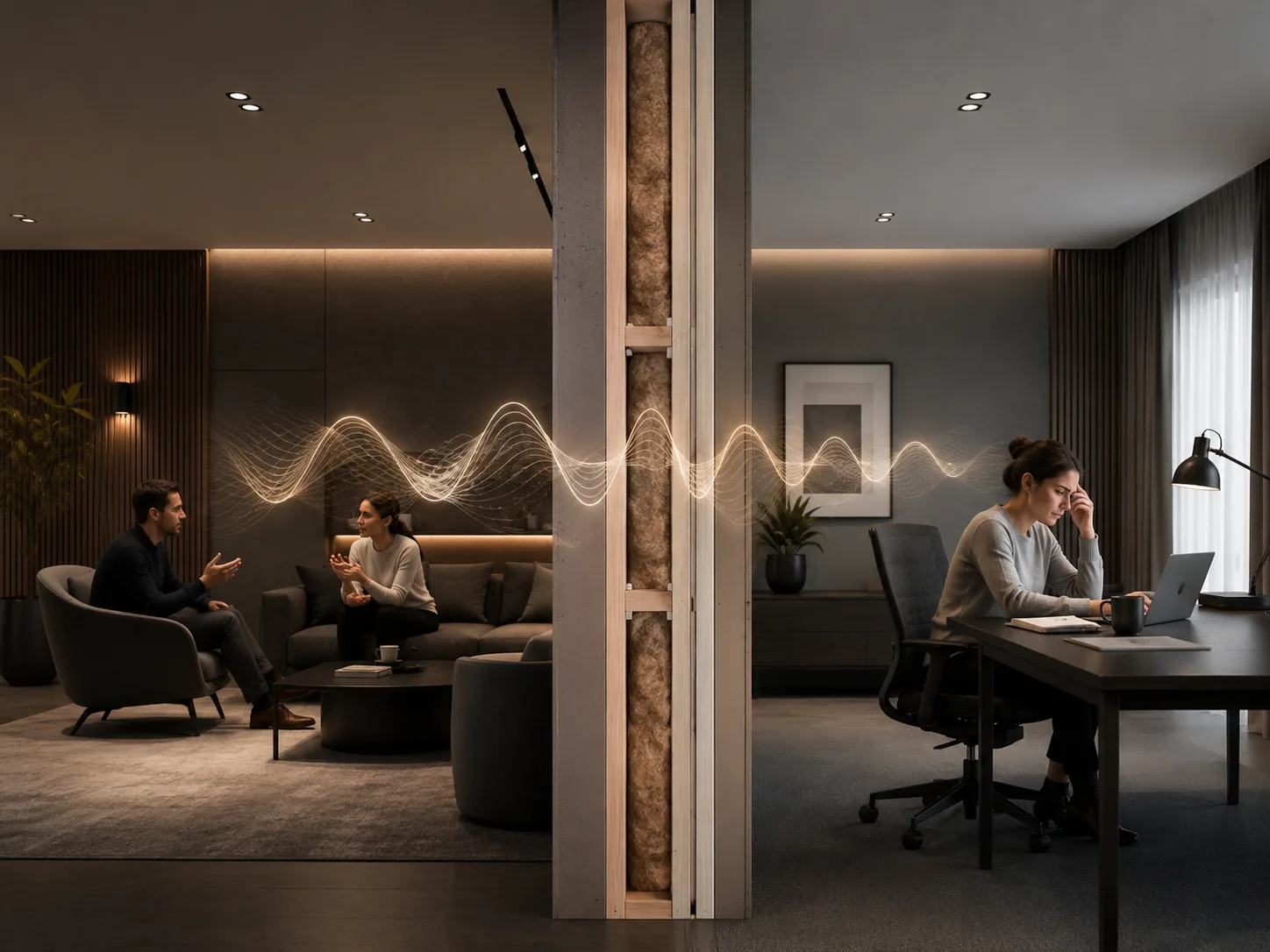
Acoustic treatment for office soundproofing in Saudi Arabia has its own constraints — room volume, activity type, fire requirements, and project budget shape every decision. This guide identifies the most common challenges in this category, the acoustic physics behind each, and the international standards your project should meet.
Common Acoustic Challenges & Solutions
Step 1: measure baselineUse a sound-level meter at typical occupied volume. Note RT60 with a clap test.
Step 2: identify hot spotsReception, lift lobby, meeting room walls, kitchenette — where noise originates or transmits.
Step 3: layered solutionMLV in critical walls + absorbers throughout + acoustic door seals on key doors.
Step 4: verify resultPost-install RT60 and ambient measurement confirms the design hit its target.
FormulaMass Law for Sound Transmission
TL ≈ 20·log₁₀(m·f) − 47 (dB)
TL is transmission loss; m is mass per unit area (kg/m²); f is frequency (Hz). Doubling mass adds 6 dB to TL. A wall of 50 kg/m² at 500 Hz achieves TL ≈ 38 dB — but real assemblies (with decoupling and damping) often exceed this by 10–15 dB.
Referenced International Standards
ASTM E90
Laboratory transmission loss measurement
Reverberation-chamber test from which Sound Transmission Class (STC) is derived.
ASTM E413
Classification — Sound Transmission Class
Single-number rating computed from the measured 1/3-octave transmission loss curve.
ISO 717-1
Airborne sound insulation rating Rw
European equivalent of STC. Standard reporting for partitions and façades.
ASTM E492
Impact insulation measurement
Lab tapping-machine test for floor/ceiling assemblies — produces IIC (Impact Insulation Class).
EN 13501-1
Reaction-to-fire classification
Applies to MLV barriers and absorber components in residential and commercial walls.
BS 5852
Furniture & furnishing fire safety
Cigarette and match-flame ignition test — required for foam panel approvals.
Reference Target Values
Metric
Target
Source / Standard
Wall STC (residential)
STC 50+
IBC 2015 §1207
Wall STC (executive)
STC 55+
WELL Standard
Floor IIC (residential)
IIC 55+
Design recommendation
Window STC (urban)
STC 36+ (laminated double glazing)
Manufacturer test
Door perimeter seal
STC +6 to +10 over bare door
ASTM E2074
MLV surface density
2–4 kg/m²
Manufacturer spec
Implementation Steps
1
Site assessmentAn engineer measures the existing acoustic environment — clap-test RT60, ambient dB(A), and surface inventory. Free service from Yamamah Smart.
2
Sabin calculationUsing room volume and surface materials, we compute the absorbing area required to hit the target RT60. The result drives panel quantity.
3
Product selectionPanel family is chosen by NRC target, fire rating, aesthetic, and budget. Verified test reports back every spec.
4
Layout & installationPanel layout is drawn against the architectural plan; installation uses approved mounting hardware (adhesive, Z-clip, or Button-Fix).
5
Post-install measurementAfter installation we re-measure RT60 and ambient dB(A) to confirm the design target was achieved. Report issued to the project owner.
Example Project Applications
Yamamah Smart has delivered installations across these categories in Saudi Arabia. Every project begins with a site survey, NRC calculation, and layered acoustic plan.
Corporate officesOpen-plan workstations + glass-walled meeting rooms in Riyadh and Jeddah, treated with ceiling absorbers and wall fabric panels.
Hospitality & F&BHotel lobbies, fine-dining restaurants, and busy cafés with hard floors and double-height ceilings — solved by suspended baffles + wall slats.
Education & worshipUniversities, classrooms, and mosques where speech intelligibility is the primary acoustic goal — controlled reverberation per ANSI S12.60.
Frequently Asked Questions
Will MLV alone soundproof my wall?
MLV is a key component but not a full solution. The proven assembly is gypsum + MLV + resilient channels + decoupled stud framing + mineral wool. Each layer addresses one of the four sound-management principles (mass, decoupling, damping, absorption).
How much can I expect STC to improve?
A standard 13 mm gypsum partition has STC ~35. Adding MLV + resilient channels + double-leaf gypsum typically reaches STC 50–55 — meeting the IBC 2015 §1207 residential requirements.
Does isolation work for low frequencies (bass)?
Low-frequency isolation requires mass — and mass works on a logarithmic scale. Doubling the mass adds ~6 dB transmission loss. For dedicated bass control (home cinema, music room) use MLV + thicker gypsum + mineral wool fill.
What about windows and doors — the weakest links?
Windows: upgrade to laminated acoustic double glazing (STC 36+). Doors: solid-core door + perimeter acoustic seal + automatic drop seal — together they add STC 8–12 over a hollow-core unsealed door.
How long does an acoustic project take in Saudi Arabia?
From site survey to commissioning, a typical commercial project takes 2–4 weeks. Residential treatments often complete in under a week. Yamamah Smart provides an indicative timeline at the survey stage.
Get a Free Acoustic Consultation
Our Yamamah Smart engineers assess your space and recommend the right panels with certified professional installation.
المعالجة الصوتية لـعزل صوتي للمكاتب في المملكة لها خصوصياتها — حجم الغرفة، نوع النشاط، متطلبات الحريق، وميزانية المشروع تشكّل كل قرار. هذا الدليل يحدّد التحديات الأكثر شيوعاً في هذه الفئة، الفيزياء الصوتية وراء كل منها، والمعايير الدولية التي يجب أن تستوفيها.
التحديات الصوتية الشائعة وحلولها
الخطوة 1: قِس خط الأساساستخدم جهاز قياس مستوى الصوت في الحجم المُشغّل العادي. لاحظ RT60 باختبار التصفيق.
الخطوة 2: حدّد النقاط الساخنةالاستقبال، ردهة المصاعد، جدران قاعات الاجتماعات، المطبخ الصغير — حيث ينشأ الضجيج أو ينتقل.
الخطوة 3: حل بطبقاتMLV في الجدران الحرجة + ممتصات في كل مكان + أختام أبواب صوتية على الأبواب الرئيسية.
الخطوة 4: تحقّق من النتيجةقياس RT60 المحيط بعد التركيب يؤكّد أن التصميم وصل إلى هدفه.
المعادلةقانون الكتلة لانتقال الصوت
TL ≈ 20·log₁₀(m·f) − 47 (dB)
TL هو فقد الانتقال؛ m هي الكتلة لكل وحدة مساحة (كغ/م²)؛ f هو التردد (هرتز). مضاعفة الكتلة تضيف 6 ديسيبل إلى TL. جدار 50 كغ/م² عند 500 هرتز يحقّق TL ≈ 38 ديسيبل — لكن التجميعات الحقيقية (مع الفصل والتخميد) تتجاوزه عادةً بـ 10-15 ديسيبل.
المعايير الدولية المرجعية
ASTM E90
قياس فقد الانتقال في المختبر
اختبار حجرة الصدى الذي يُشتقّ منه فئة انتقال الصوت (STC).
ASTM E413
التصنيف — فئة انتقال الصوت
تصنيف واحد يُحسَب من منحنى فقد الانتقال بمقاييس الثلث-أوكتاف.
ISO 717-1
تصنيف العزل الصوتي الجوي Rw
المكافئ الأوروبي لـ STC. الإبلاغ القياسي للقواطع والواجهات.
ASTM E492
قياس عزل التأثير
اختبار آلة الطرق لتجميعات الأرضيات/الأسقف — يُنتج IIC (فئة عزل التأثير).
EN 13501-1
تصنيف رد الفعل للحريق
يطبّق على حواجز MLV ومكوّنات الممتصات في الجدران السكنية والتجارية.
التعليم والعبادةالجامعات والصفوف والمساجد حيث وضوح الكلام هو الهدف الصوتي الرئيسي — رنين متحكَّم به وفق ANSI S12.60.
الأسئلة الشائعة
هل MLV وحده يعزل جداري صوتياً؟
MLV عنصر أساسي لكنه ليس حلاً كاملاً. التجميع المُثبَت هو جبس + MLV + قنوات مرنة + هيكل مفصول + صوف معدني. كل طبقة تعالج مبدأ من المبادئ الأربعة (الكتلة، الفصل، التخميد، الامتصاص).
كم يمكن لـ STC أن يتحسّن؟
قاطع جبس قياسي 13 مم له STC ~35. إضافة MLV + قنوات مرنة + جبس مزدوج تصل عادةً STC 50-55 — ملبّيةً متطلبات IBC 2015 §1207 السكنية.
هل العزل يعمل للترددات المنخفضة (الباس)؟
عزل الترددات المنخفضة يتطلّب كتلة — والكتلة تعمل على مقياس لوغاريتمي. مضاعفة الكتلة تضيف ~6 ديسيبل من فقد الانتقال. للتحكم المخصّص بالباس (سينما منزلية، غرفة موسيقى) استخدم MLV + جبس أسمك + تعبئة صوف معدني.
ماذا عن النوافذ والأبواب — أضعف الحلقات؟
النوافذ: ارتق إلى زجاج صوتي مزدوج مصفّح (STC 36+). الأبواب: باب صلب + ختم محيطي صوتي + ختم سفلي تلقائي — معاً يضيفون STC 8-12 فوق باب مجوّف غير مختوم.
كم تستغرق المعالجة الصوتية في السعودية؟
من مسح الموقع إلى التشغيل، يستغرق مشروع تجاري نموذجي 2-4 أسابيع. المعالجات السكنية تكتمل غالباً خلال أسبوع. اليمامة الذكية تقدّم جدولاً زمنياً إرشادياً في مرحلة المسح.
اطلب استشارة صوتية مجانية
فريق مهندسي اليمامة الذكية يقيّم مساحتك ويوصي بالألواح المناسبة مع تركيب احترافي معتمد.
Tabuk and NEOM is a significant Saudi city with major projects and unique acoustic requirements. Yamamah Smart delivers acoustic treatment for mosques, offices, schools, and restaurants across the cit...
Riyadh is a significant Saudi city with major projects and unique acoustic requirements. Yamamah Smart delivers acoustic treatment for mosques, offices, schools, and restaurants across the city. This ...
The bedroom is now an office, a podcast studio, and a sleep sanctuary all at once. This Yamamah Smart field toolkit covers the 5-piece bedroom acoustic stack — mass barrier, panels, door seal, window treatment, HVAC silencer — plus 3 strategies by budget and 5 KSA-specific use cases.