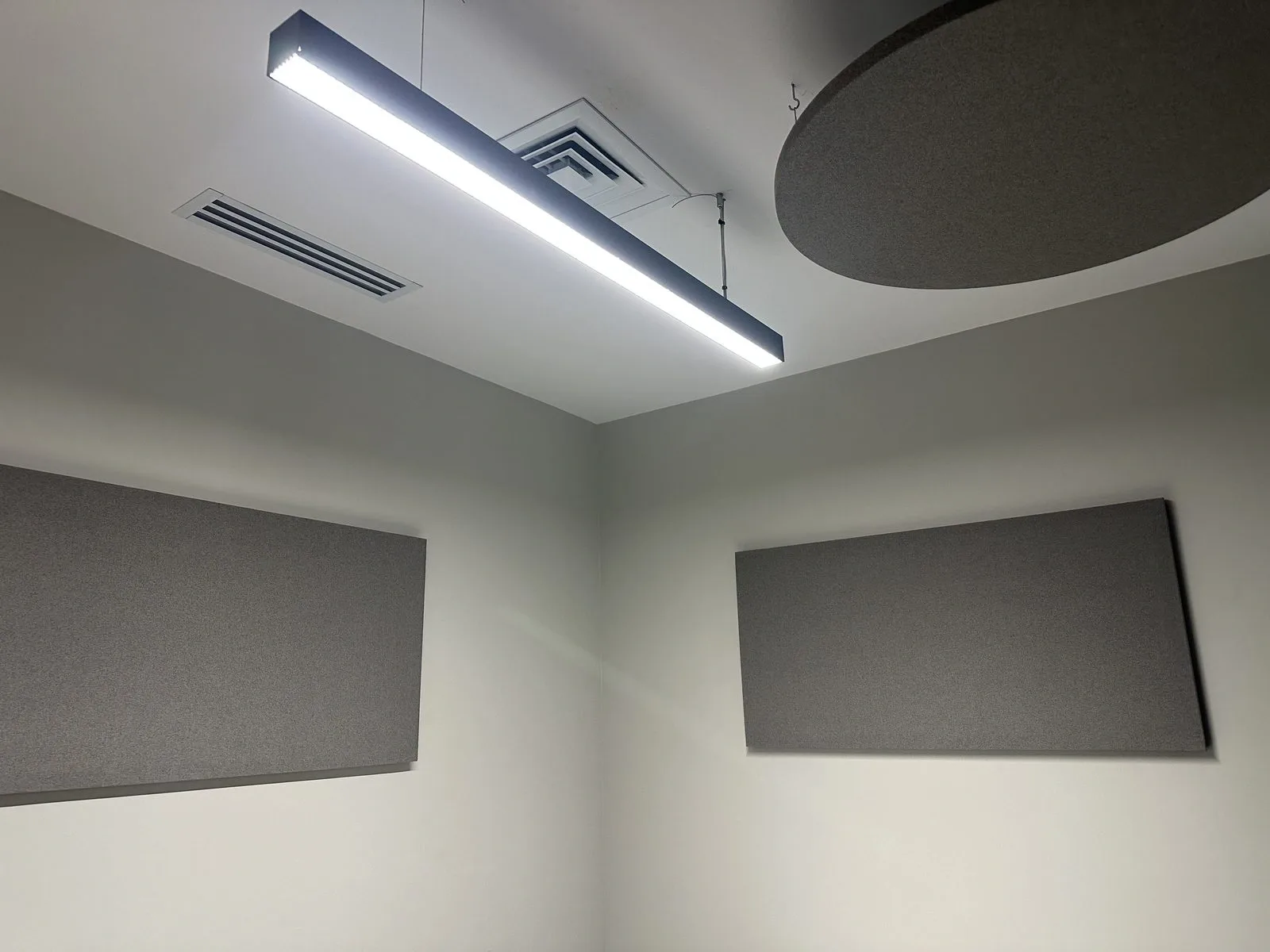
Definition
Sound Transmission Loss (TL) is the frequency-dependent reduction in sound energy as it passes through a building element — a wall, floor, ceiling, door or window. It is expressed in decibels (dB); a higher TL means better blocking of airborne sound.
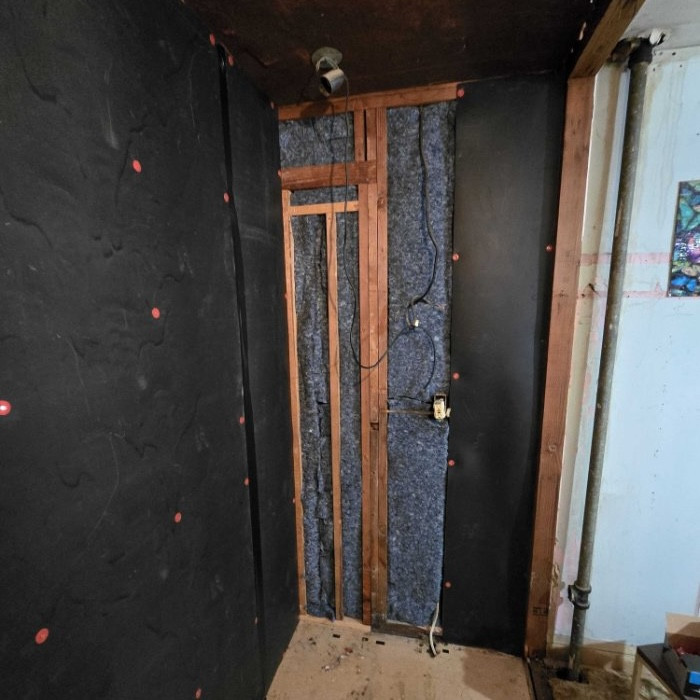
What It Measures
TL measures airborne sound insulation — how much sound the element blocks from passing between two rooms. It is the underlying, frequency-dependent quantity from which the single-number ratings STC (ASTM) and Rw (ISO) are derived.
Units
TL is expressed in decibels (dB) and is frequency-dependent (reported per frequency band).
Formula
TL is related to the transmission coefficient (τ), the fraction of incident sound power transmitted through the element:
TL = 10 × log10(1 / τ)
where τ = transmitted power / incident power.
Measurement
- Laboratory: a sample is installed between two rooms; sound is generated in the source room and measured on both sides across frequency bands (per ASTM E90 / ISO 10140).
- Field: on-site measurement gives the apparent performance, which is usually lower due to flanking (per ASTM E336 / ISO 16283).
From TL to a Single Number
- STC — rated from the TL curve per ASTM E413.
- Rw — rated from the sound reduction index curve per ISO 717-1.
Relevant Standards
- ASTM E90 — laboratory measurement of airborne sound transmission loss.
- ASTM E413 — classification (STC).
- ISO 10140 — laboratory measurement of sound insulation.
- ISO 717-1 — rating (Rw).
Limitations
- TL is frequency-dependent; a single number (STC/Rw) condenses the curve and can hide low-frequency weakness.
- Laboratory TL isolates the element; field performance is lower due to flanking and installation.
- TL describes insulation, not absorption (NRC) or reverberation (RT60).
Common Mistakes
- Confusing TL with sound absorption (NRC).
- Assuming laboratory TL equals field performance.
- Treating STC/Rw as a material property rather than a tested assembly.
Related Yamamah Solutions
For insulation of walls and partitions, contact us for a free acoustic consultation.
Frequently Asked Questions
Is TL the same as STC? No. TL is the frequency-dependent curve; STC is the single-number rating derived from it.
Does high TL mean good absorption? No. TL describes blocking sound between rooms; absorption (NRC) describes echo control inside a room.
Verified Sources
- ASTM E90 — Laboratory measurement of airborne sound transmission loss.
- ASTM E413 — Classification for rating sound insulation.
- ISO 10140 / ISO 717-1 — Sound insulation measurement and rating.
Related acoustic products
Systems specified for this application and supplied with installation across Saudi Arabia:
- Mass loaded vinyl (MLV) — STC 33 barrier for walls, ceilings and floors — blocks, does not absorb.
- Acoustic door seals — Perimeter gaskets and drop seals, +Rw 5–8 dB.
- MLV soundproofing membrane — 3 mm × 1,800 kg/m³ flexible barrier.
Send the room data and we return a specification review: contact Yamamah Smart.