
Can Acoustic Foam Soundproof a Room?
The Real Truth About Acoustic Foam – Yamamah Smart Saudi Arabia**
Understanding What Acoustic Foam Can (and Cannot) Do
When people search for ways to reduce noise, one of the most common questions we hear is:
Can acoustic foam soundproof a room?
The honest and professional answer is: No, acoustic foam does not soundproof a room.
However, acoustic foam plays a very important role in improving sound quality inside a space.
At Yamamah Smart Saudi Arabia, we believe that understanding the difference between sound absorption and soundproofing is the key to choosing the right solution. This article explains the real function of acoustic foam panels, when to use them, and when you need additional soundproo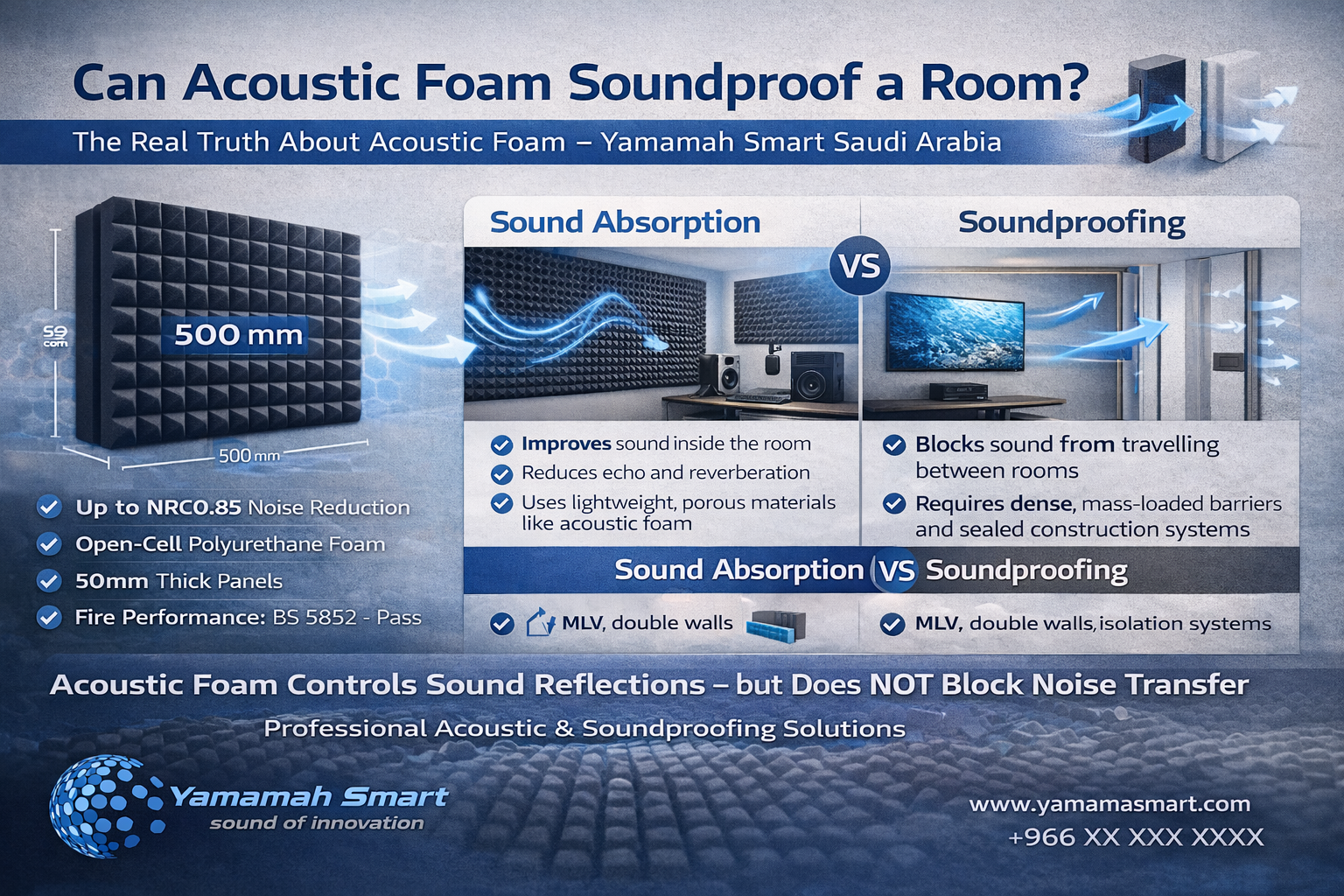 fing materials.
What Acoustic Foam Actually Does
Acoustic foam is designed to absorb sound reflections inside a room. It reduces:
- Echo and reverberation
- Reflected noise from hard surfaces
- Sound distortion and poor speech clarity
This makes acoustic foam ideal for:
- Recording studios
- Podcast and voice-over rooms
- Gaming rooms
- Offices and meeting rooms
- Home theaters and cinemas
Acoustic foam improves how sound behaves inside the room, but it does not stop sound from entering or leaving the space.
Why Acoustic Foam Cannot Soundproof a Room
To block sound, you need mass, density, and airtight construction. Acoustic foam is lightweight and porous, which makes it excellent for absorption—but ineffective as a sound barrier.
Soundproofing requires:
- Heavy materials that block sound transmission
- Sealed construction with no gaps
- Decoupling of walls, ceilings, or floors
This is why foam alone cannot stop loud music, machinery noise, or voices from traveling through walls.
Soundproofing vs Sound Absorption – The Key Difference
Sound Absorption
- Controls sound reflections inside the room
- Improves clarity and acoustic comfort
- Uses materials like acoustic foam, fabric panels, felt panels
Soundproofing
- Blocks sound from traveling between spaces
- Requires mass-loaded barriers and construction systems
- Uses materials like Mass Loaded Vinyl (MLV), double walls, and isolation systems
Professional rule:
If your goal is better sound quality → use acoustic foam
If your goal is noise containment → you need soundproofing systems
YAMSIS Foam Acoustic Panels by Yamamah Smart
At Yamamah Smart, we supply YAMSIS Foam Acoustic Panels, engineered for reliable sound absorption and long-term performance.
Technical Specifications (Summary)
- Material: Open-cell polyurethane acoustic foam
- Panel Size: 500 × 500 mm
- Thickness: 50 mm
- Density: 30 kg/m³ (EN 1936)
- Noise Reduction: Up to NRC 0.85*
- Acoustic Performance: ISO 354:2003 – 0.80 (50 mm thickness)
- Application: Walls and ceilings
- Color: Black
- Fire Performance: BS 5852 – Pass
*Actual performance depends on room size, coverage area, and installation method.
YAMSIS Foam
Where Acoustic Foam Works Best
YAMSIS Foam Acoustic Panels are suitable for:
- Recording studios & audio rooms
- Gaming rooms and streaming setups
- Offices and meeting rooms
- Residential home theaters
- Cinemas and auditoriums
- Industrial and OEM acoustic treatment
They are especially effective when used on reflection points, rear walls, and ceilings to reduce reverberation time and improve speech intelligibility.
Steps to a Complete Noise Control Solution
For professional results, acoustic foam should be part of a complete acoustic strategy:
1️⃣ Identify the Noise Problem
Is the issue echo inside the room—or noise leaking in or out?
This determines whether you need absorption, soundproofing, or both.
2️⃣ Seal Gaps and Weak Points
Even small gaps around outlets, doors, or ceiling edges allow sound to leak.
3️⃣ Add Soundproofing Where Needed
Use high-mass materials such as MLV sound barriers to block airborne noise through walls, floors, and ceilings.
4️⃣ Install Acoustic Foam Panels
Apply acoustic foam to absorb reflected sound, reduce echo, and enhance clarity inside the room.
5️⃣ Combine Systems for Best Results
The most effective projects use soundproofing + absorption, not one alone.
Acoustic Foam vs True Soundproofing Materials
- Acoustic Foam: Improves sound quality inside the room
- MLV Sound Barriers: Block sound transmission
- Gypsum Systems & Isolation: Prevent vibration transfer
Expert insight:
Acoustic foam is not a replacement for soundproofing—it is a complementary solution.
Conclusion
Acoustic foam is an essential acoustic treatment, but it is not a soundproofing material. When used correctly, it dramatically improves sound clarity, comfort, and acoustic balance inside a space. For true noise control, it must be combined with proper soundproofing systems.
At Yamamah Smart Saudi Arabia, we design and deliver complete acoustic and soundproofing solutions, ensuring each project uses the right materials for the right purpose.
Contact Yamamah Smart – Acoustic & Insulation Experts in Saudi Arabia
📍 Location: Riyadh, Saudi Arabia
📞 Phone / WhatsApp: +966 506 600 672
📧 Email: Ahmad@yamamahsis.com
🌐 Website: https://www.yamamahsis.com
Can Acoustic Foam Soundproof a Room?